Search This Blog

Wednesday, 19 November 2025

#SaudiArabia leads $900mn funding round in Luma AI as US ties deepen

Saudi Arabia leads $900mn funding round in Luma AI as US ties deepen

Saudi Arabia is backing a $900mn funding round in US video start-up Luma AI, as the Gulf state steps up efforts to become a global force in the development of artificial intelligence. 

The deal, led by Humain, the AI-focused venture backed by the kingdom’s sovereign wealth fund, values Luma at more than $4bn, according to people close to the negotiations.  

The deal will be announced in Washington at this week’s US-Saudi Investment Forum, led by Crown Prince Mohammed bin Salman as part of a number of new deals with US companies. Those follow a wave of tie-ups announced during Donald Trump’s visit to Riyadh in May. 

Saudi Arabia wants to use the financial muscle of its near-$1tn Public Investment Fund to become an international leader in AI. Prince Mohammed said during his meeting with the US president in the Oval Office on Tuesday that his country planned to spend about $50bn on AI “in the short term”.  

Luma, which is based in Burbank, California, creates generative video models that can respond to prompts to create movies or simulate reality. The new funding will accelerate Luma’s efforts to train large-scale “world models” that learn from videos and robotic data rather than just language. 

Big Tech groups such as Google DeepMind and Meta, as well as start-ups such as Fei Fei Li’s World Labs, are spending billions of dollars in the race to build these new “spatial intelligence” systems.

Jain, co-founder of Luma, said: “To create AI that can help humanity in the physical world and expand our understanding of the universe, we need to build systems that can learn from a quadrillion tokens of information — roughly the collective digital memory of humanity — contained in video, image, audio and language.” 

Meanwhile, Humain is building Project Halo, one of the world’s largest data centre clusters that will provide some computational power for Luma. The deal includes an initiative to build AI models trained on Arabic and regional data to create “culturally aligned” AI. 

Existing investors, such as Andreessen Horowitz, Amplify Partners and Matrix Partners have also participated in Luma’s new funding round, alongside new investors including AMD Ventures. 

Saudi Arabia and PIF have recalibrated their spending and priorities as lower oil prices put pressure on the kingdom’s budget in recent years. But AI remains one of the main areas where it is willing to spend as part of wider plans to diversify the economy away from its dependence on oil revenues. 

Humain chief executive Tareq Amin told the Financial Times earlier this year that the company had allocated $10bn for AI investments through a venture capital fund, while it continued talks with Nvidia and other semiconductor companies to secure the chips needed to build data centres in the kingdom.

Mideast Stocks: Gulf markets dip amid caution ahead of Nvidia earnings, US jobs data

Mideast Stocks: Gulf markets dip amid caution ahead of Nvidia earnings, US jobs data


Most Gulf stock markets ended lower on Wednesday, tracking global peers as investors turned cautious ahead of Nvidia's quarterly earnings and a key delayed U.S. jobs data report, while weaker oil prices also weighed on sentiment.

Oil, a key driver for Gulf financial markets, fell on oversupply concerns, though U.S. sanctions on major Russian producers helped limit losses. Brent crude was down 2.5% at $63.3 a barrel by 1300 GMT. 

Dubai's benchmark stock index was down 0.6%, pressured by broad-based losses. Emaar Properties fell 1.1% and Dubai Electricity and Water Authority slipped 2.6%.

The Abu Dhabi benchmark index fell 0.2%, extending losses into a sixth session and hitting a near five-month low. First Abu Dhabi Bank, the UAE's largest lender, lost 1.2% and Abu Dhabi Islamic Bank declined 1.5%, while Presight AI Holding added 2.2%.

Separately, South Korea agreed to work with the United Arab Emirates on the U.S.-backed Stargate project to build a large artificial intelligence data campus in the Gulf state, Seoul said on Tuesday.

Saudi Arabia's benchmark stock index was down 0.9%, with almost all sectors in negative territory, led by healthcare, real estate and information technology. Al Rajhi Bank declined 1.6% and Arabian Internet and Communications Services Co lost 1.7%.

"GCC markets mostly trended lower as investors stayed cautious ahead of Nvidia's earnings after the U.S. close," said Daniel Takieddine, co-founder and CEO of Sky Links Capital Group, adding that the report is seen as a key gauge for the AI sector amid worries over stretched valuations and heavy capital flows into artificial intelligence.

The Qatari benchmark index snapped a five-session losing streak, rising 0.6%, with almost all stocks advancing. Industries Qatar gained 3%, while Ooredoo added 1.9%. 

Markets are now awaiting Thursday's delayed September non-farm payrolls report, with traders pricing about a 42% chance of a 25-basis-point Federal Reserve rate cut in December, down from near certainty a month ago. U.S. monetary policy moves are closely followed in the Gulf, where most currencies are pegged to the dollar.

Outside the Gulf, Egypt's blue-chip index ended little changed, supported by a 6.1% gain in Misr Cement and a 2.3% rise in E-Finance For Digital And Financial Investments , which said it was formulating a new three-year investment strategy.

#AbuDhabi Fund Tripled Bitcoin Bet in Months Before Crypto Crash - Bloomberg

Abu Dhabi Fund Tripled Bitcoin Bet in Months Before Crypto Crash - Bloomberg


The Abu Dhabi Investment Council more than tripled the size of its position in a Bitcoin exchange-traded fund during the third quarter, shortly before the bull market in cryptocurrencies gave way to a brutal selloff.

The firm, an independently-run unit of sovereign wealth fund Mubadala Investment Co., increased its holding in BlackRock Inc.’s iShares Bitcoin Trust ETF to almost 8 million shares as of Sept. 30, according to a regulatory filing. The position, disclosed by a subsidiary of ADIC, was worth about $518 million at the time. It held 2.4 million shares three months earlier.

Bitcoin rallied to a record $126,251 in early October, driven partly by massive inflows into exchange-traded funds like the iShares Bitcoin Trust ETF, which is by far the world’s largest crypto ETF with more than $70 billion in assets. Then came a market crash sparked by liquidations of billions of dollars in leveraged bets that sent Bitcoin tumbling below $92,000.

The disclosures offer a rare detailed look into the strategy being pursued by ADIC, which invests mostly in private assets in areas like buyouts, infrastructure and real estate. A representative for ADIC said it’s building a small allocation to Bitcoin as part of a long-term diversification strategy.

“We view Bitcoin as a store of value similar to gold, and as the world continues to move toward a more digital future, we see Bitcoin playing an increasingly important role alongside gold,” the ADIC spokesperson said in response to Bloomberg News queries. “Both assets contribute to diversifying our portfolio, and we expect to hold them as part of our near and long-term strategy.”
Record Outflows

Mubadala separately disclosed that it owned 8.7 million shares valued at $567 million in the same Bitcoin ETF, known by its ticker symbol IBIT, at the end of the third quarter. That’s unchanged from its holding three months earlier.

Details on the purchase prices weren’t immediately available. IBIT — which tracks the value of Bitcoin — has lost about a fifth of its value since Sept. 30, after advancing 6.2% in the third quarter. It traded at a volume-weighted average price of $64.52 during the third quarter, Bloomberg data show.

ADIC wasn’t alone in adding to its position last quarter, with Harvard Management Co. also boosting its holdings in IBIT during that period.

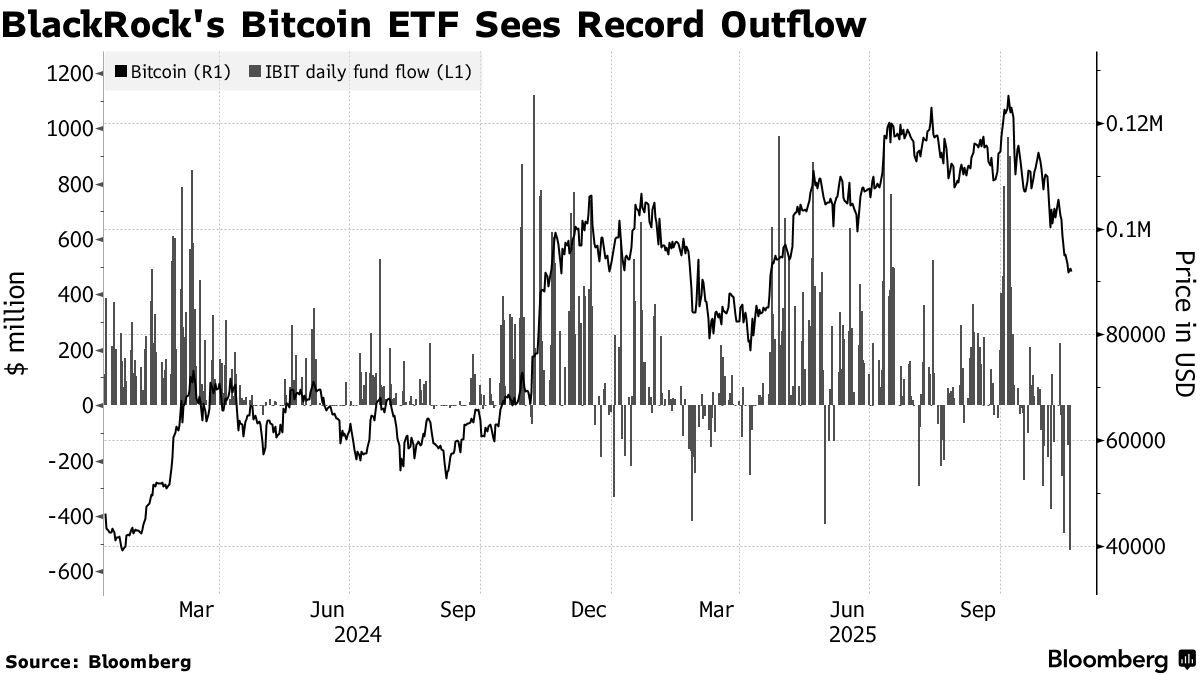
But investors have pulled back overall as markets turned. So far in November, about $3.1 billion has been yanked from a group of 12 spot US Bitcoin ETFs including IBIT, data compiled by Bloomberg show. IBIT suffered a record $523 million in outflows on Tuesday, after Bitcoin dipped below a key price point that meant the average investor in US ETFs tracking the token was sitting on losses.

Abu Dhabi’s moves into the sector hold particular significance given its vast financial resources. The city’s wealth funds oversee more than $1.7 trillion, and Mubadala has already been a key driver of the emirate’s emergence as a global crypto hub in recent years.

Earlier this year, a technology investment firm jointly established by the $330 billion wealth fund bought a $2 billion stake in crypto exchange Binance. The fund, called MGX, did that deal using a so-called stablecoin issued by a company affiliated with the family of US President Donald Trump.

Mubadala absorbed ADIC a few years ago, though the two funds continue to operate separately. Initially set up in 2007, ADIC has been expanding its senior executive ranks as it seeks to step up global investments.

It recently hired Alain Carrier, the former chief executive officer of private markets firm Bregal Investments, as the executive director of its private equity business. Before his stint at Bregal, Carrier was the head of international business at Canada Pension Plan Investment Board.

ADIC has also hired Ben Samild, who was previously the investment chief of Australia’s A$252 billion ($164 billion) sovereign wealth fund, as its chief strategist.

ADIC adopts an endowment investment model, and focuses predominantly on private assets and, geographically, on North America. Its latest move indicates that global institutions — and even governments — are continuing to pile into crypto assets despite the sector’s notorious volatility.

El Salvador President Nayib Bukele, an early crypto advocate, made Bitcoin legal tender in 2021. The country added more than $100 million to its Bitcoin holdings this week.

The Czech central bank last week announced its first-ever purchase of cryptocurrencies, as officials seek to determine if digital assets have a role to play in diversifying reserves. The $1 million investment will be kept separate from the central bank’s official foreign reserves, it said.

And earlier in November, Kazakh central bank governor Timur Suleimenov told Bloomberg News that the country is building a national cryptocurrency reserve fund of as much as $1 billion, in part by using assets seized and repatriated from abroad.

Brookfield Targets $10 Billion for AI Fund in Nvidia Pact - Bloomberg

Brookfield Targets $10 Billion for AI Fund in Nvidia Pact - Bloomberg

Brookfield Asset Management Ltd. is targeting $10 billion of fund commitments for a global artificial-intelligence infrastructure program in partnership with Nvidia Corp. and the Kuwait Investment Authority.

New York-based Brookfield said it will anchor the program with the Brookfield Artificial Intelligence Infrastructure Fund, which launches Wednesday. BAIIF has already received $5 billion of capital commitments from institutional and industry partners, including Brookfield, Nvidia and the Kuwait Investment Authority, according to a statement Wednesday.

BAIIF plans to acquire as much as $100 billion of AI assets using co-investments and leverage, with purchases across energy, land, data centers and other parts of the infrastructure chain. Last month, Brookfield agreed to invest as much as $5 billion to deploy Bloom Energy Corp.’s fuel cells at new data centers, marking its first investment through the new strategy.

Brookfield, which manages about $1 trillion of assets, is among the key players providing private capital in the AI build-out, and has estimated that it will cost $7 trillion to build AI infrastructure over the next decade.

BAIIF will focus on investing in the physical infrastructure assets that underpin the delivery of AI, including factories, dedicated behind-the-meter power solutions and compute infrastructure, according to the statement.

Nvidia has made significant investments in AI over the past few months, including agreeing to invest as much as $15 billion in Anthropic and around $100 billion in OpenAI.

Lukoil’s Suitor List Expands to Exxon, Chevron, #AbuDhabi - Bloomberg

Lukoil’s Suitor List Expands to Exxon, Chevron, Abu Dhabi - Bloomberg

Exxon Mobil Corp., Chevron Corp., Abu Dhabi National Oil Co. as well as US private equity giant Carlyle Group are among companies interested in Lukoil PJSC’s international assets, a sale hastened by US sanctions due to kick in next month.

Suitors are lining up to look at the various parts of Russian energy giant’s sprawling international business, with some potential buyers only interested in specific assets, according to people familiar with the situation. But one potential problem is that Lukoil favors selling the assets as a single package ahead of sanctions due to take effect Dec. 13, one of the people said.

This raises the possibility of a two-step process in which one buyer — such as a financial firm — acquires all of Lukoil’s non-Russian assets and then resells them piecemeal over time.

A key detail in the process is that the Trump administration would prefer that Lukoil’s global assets are taken over by a US entity, a fact that may limit the pool of potential buyers, people with knowledge of the matter said. A spokesperson for the US Treasury didn’t immediately respond to a request for comment.

Lukoil had previously agreed to sell the whole international business to Gunvor Group — a deal that was then dramatically blocked by the US.

Exxon and Chevron are exploring Lukoil’s stake in the West Qurna 2 field in Iraq, said two of the people, who declined to be identified because the talks are private.

Meanwhile Adnoc is looking at various Lukoil assets, with the Russian firm’s natural gas operations in Uzbekistan potentially of most interest, according to people with knowledge of the situation.

Spokespeople for Chevron, Exxon, Carlyle and Adnoc’s international investment unit XRG all declined to comment. Lukoil didn’t respond to a request to do so.